A manufacturer specializing in the production and research and development of testing machines, integrating pre-sales consultation, research and development, production, manufacturing, and service
Current location:
Home >
News>
Company News>Hydraulic Universal Testing Machine: Planning a Laboratory Installation
A hydraulic universal testing machine should be planned as a laboratory installation, including its power unit, controls, accessories, handling space, and measurement requirements. Focusing only on the frame footprint can leave important practical work until delivery. A coordinated installation plan makes it easier to bring the machine into routine service. This guide outlines the information an overseas buyer should gather before confirming the location and final configuration.
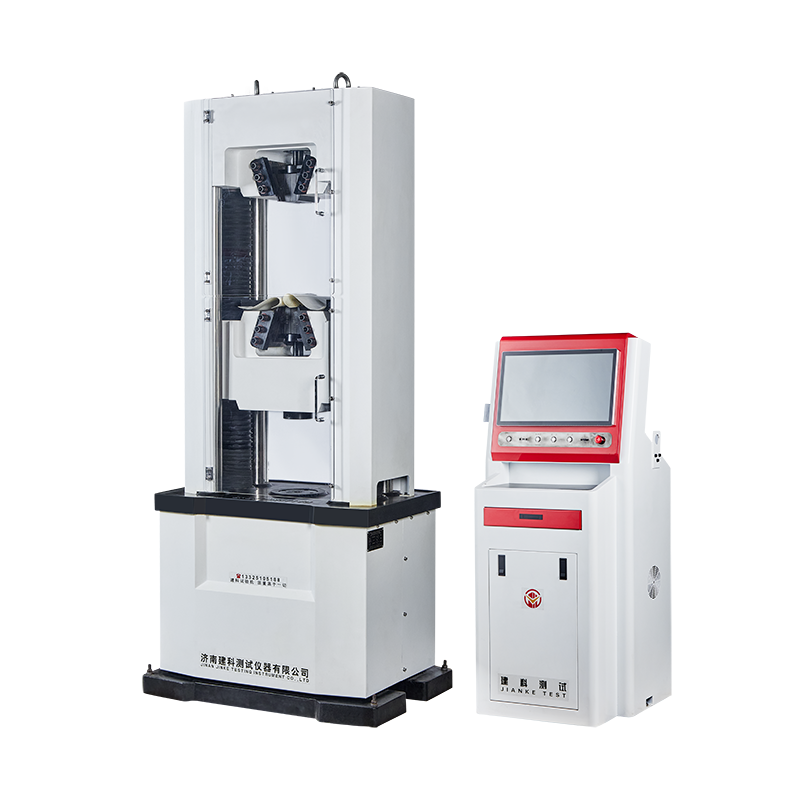
WAW-D — Electro-hydraulic servo hydraulic universal testing machine. Product illustration. Confirm the exact configuration for your specimens.
Allocate space for people, specimens, and service access
Start with the supplier's installation drawing for the offered model. Identify the loading frame, power unit, control cabinet, computer, and any equipment needed to handle specimens and fixtures. Add the space in which the operator works and the route used for removing a broken specimen. The resulting arrangement is usually more informative than the frame's width and depth alone.
Next review utilities and access with the receiving team. Electrical supply, earthing, ambient conditions, and any cooling requirements should be confirmed before shipment. The route from unloading point to final position should accommodate the delivered assembly and approved lifting arrangements. Obtain the relevant floor or foundation requirements rather than assuming that an existing laboratory floor is suitable.
Plan commissioning as an activity with named responsibilities. The buyer may provide the site and utilities, while the supplier provides positioning guidance, setup, and training under the agreed scope. Calibration and acceptance may involve an additional provider. Clarify those boundaries in advance so that delivery, installation, and readiness for testing do not become three unrelated milestones with unresolved work between them.
An illustrative application review
In an illustrative installation review, the frame fits the proposed room, but a cabinet door cannot open once the power unit is positioned beside it. A revised layout preserves service access and gives the operator a clear specimen-loading area. The buyer also checks doorway dimensions before transport is booked. Resolving these issues on a drawing is simpler than moving a commissioned system and repeating the checks affected by its relocation.
Plan installation around the supplied assembly
Obtain the dimensions and weights of the complete system, including its control cabinet, power unit, computer, accessories, and transport packaging. Check doorways, floor access, lifting arrangements, operating clearance, and service access before delivery. A frame that fits the available floor area may still be difficult to install if the route into the laboratory has not been measured.
Confirm electrical requirements, protective earthing, ambient limits, and any hydraulic, pneumatic, or cooling connections for the quoted model. Foundation and anchoring requirements should follow the supplier's installation instructions and local engineering requirements. Identify the people responsible for unloading, positioning, commissioning, and calibration. Reserve time for installation checks before accepting production samples. The first operational test should establish that the assembled system works correctly in its final location, with the intended utilities and accessories.
Evaluate the hydraulic system as a complete circuit
For a hydraulic testing system, ask how the actuator, pressure source, valves, transducer, and controller work together over the proposed test range. Pressure is part of the drive mechanism, while the force measurement arrangement must be established for the actual machine. Do not treat pump power, pressure rating, and verified specimen force as interchangeable specifications.
Discuss warm-up, oil condition, leakage inspection, filtration, cooling needs, noise, and the location of the power unit. The appropriate arrangements depend on the supplied model and operating duty. For frequent low-rate or hold segments, demonstrate the control behaviour with a representative specimen and review the resulting history. Ask how the manufacturer supports troubleshooting and replacement parts for the circuit. Those practical details affect the laboratory's ability to maintain consistent operation after the initial acceptance test.
Include specimen-specific protective arrangements
The risk during a mechanical test depends on the specimen and fixtures as well as the applied force. Brittle fragments, released strain energy, moving grips, pinch points, and unsecured adapters can require different protective arrangements. Select enclosures, shields, operating distances, and handling practices through the laboratory's assessment and the equipment instructions. An emergency stop is one protective function within that arrangement.
During commissioning, demonstrate the intended overload response, travel limits, stopping behaviour, and safe procedure for changing fixtures. Define how the system is isolated before maintenance or adjustment near moving or pressurized parts. Training should include the materials actually tested and the action required after a specimen behaves unexpectedly. Make accessory load ratings easy to identify. A machine's frame capacity does not authorize loading a smaller fixture, adapter, or extensometer beyond its own operating limits.
Train for the laboratory's normal and abnormal cases
Operator training should follow the real specimen workflow, from identification and dimensional measurement to fixture installation, method selection, testing, and report review. Let the laboratory's staff perform the steps while the trainer observes. Demonstrating the start button alone leaves important sources of variation outside the training record.
Include safe response to specimen slippage, unusual fracture, overload indication, interrupted power, and a failed routine check. Explain which adjustments the operator may make and which require an authorized service or method review. Keep concise work instructions next to the equipment and identify the approved software templates. When several shifts use the same system, compare how operators prepare and load the same specimen type. Consistent handling and a clear escalation process help maintain usable results long after commissioning.
Specify the controlled quantity and the rate sequence
A test speed written as a single number may hide several different requirements. A method might control crosshead motion, force, stress, strain, or another signal during different stages. These quantities are related, but their numerical rates cannot be substituted without accounting for specimen geometry and the behaviour of the test system. The selected control signal must be measured and available over the relevant stage.
Ask for a demonstration of transitions between stages, including the approach to the specimen, the initial loading region, yielding, and the stopping condition. Inspect the recorded control history rather than relying only on the final strength value. A well-defined method also identifies the permitted operator actions. Saving the full rate sequence with the test record makes it easier to distinguish an equipment problem from a method setting that changed between otherwise similar batches.
Size the force measurement system for the actual specimens
Start with the largest credible breaking load and the smallest load that must be measured reliably. For a tensile specimen, an initial engineering estimate is expected tensile stress multiplied by original cross-sectional area. If stress is expressed in MPa and area in square millimetres, the result is newtons. This estimate helps select a configuration, but it does not replace representative sample testing. Allow for material variability and the approved operating limits of the frame, grips, fixtures, and sensor.
A high frame capacity does not establish measurement quality at every lower force. Ask for the verified working interval of each force transducer in the direction being used. A laboratory testing both strong steel and light plastic specimens may need different load cells or separate equipment. Compare uncertainty, usable measuring range, overload protection, and installation effort instead of choosing solely from the largest number on the quotation.
Make data recovery part of commissioning
Agree where the machine stores methods, raw data, reports, and configuration files, then test a backup and recovery procedure. A copy of a finished PDF cannot recreate the original channels or method settings if the computer fails. Conversely, a folder containing measurement files may be insufficient if its database, licence, or software version is missing.
Assign responsibility for backup frequency, access rights, and periodic recovery checks. Keep at least one appropriate copy separate from the operating computer according to the laboratory's information-security rules. Ask what support is available when the computer or controller is replaced and how older data remain readable. During acceptance, retrieve a saved test after restarting the application and produce the report again. This provides practical evidence that the laboratory can use its results beyond the day of testing.
Record conditioning and laboratory conditions
Temperature and prior conditioning can affect material response and the measuring equipment. This is especially significant for polymers, elastomers, and moisture-sensitive materials, but environmental records also help investigate inconsistencies in metal testing. Specify the required conditioning procedure and test environment from the applicable method and product specification. Avoid assuming that time spent next to the machine is an adequate conditioning process.
If an environmental chamber is required, confirm the usable space with the actual grips, extensometer, and specimen installed. Check how the specimen temperature is established and recorded, how cables and sensors enter the chamber, and how the operator changes specimens. A chamber's stated temperature capability is only one part of a usable test arrangement. The laboratory should be able to explain which environmental conditions applied to each specimen and whether any departure affected the interpretation of its result.
Frequently asked questions
Is the machine footprint enough for laboratory space planning?
No. Include the full supplied assembly, operator access, specimen handling, service clearance, transport route, and any required protective arrangement. Confirm the final layout with the equipment installation instructions.
What should I send with a configuration inquiry?
Send specimen drawings or photographs, material and dimension ranges, expected forces, required properties, test methods, workload, and installation conditions. Ask the supplier to identify the proposed sensors, grips, software functions, verification, and acceptance procedure. A representative sample demonstration can help resolve details that a model name alone cannot establish.
Discuss the application with Jinan Jianke
Jinan Jianke supplies material testing equipment for laboratory and production applications. Use the WAW-D product page as a starting point for an application discussion. Send your specimen information and required method through our contact page, and request a configuration-specific proposal, documentation, and representative test evidence.
Standards references
Identify the method applicable to your material and contract, and consult its full requirements. Relevant official catalogue entries include ISO 6892-1, ASTM E8/E8M. Listing a standard does not establish conformity of a particular machine configuration or completed test.
Talk to an application specialist
Request a Quote
Share your testing requirements. We will reply with a suitable configuration and quotation within one business day.
Technical selectionWorldwide deliveryAfter-sales support